





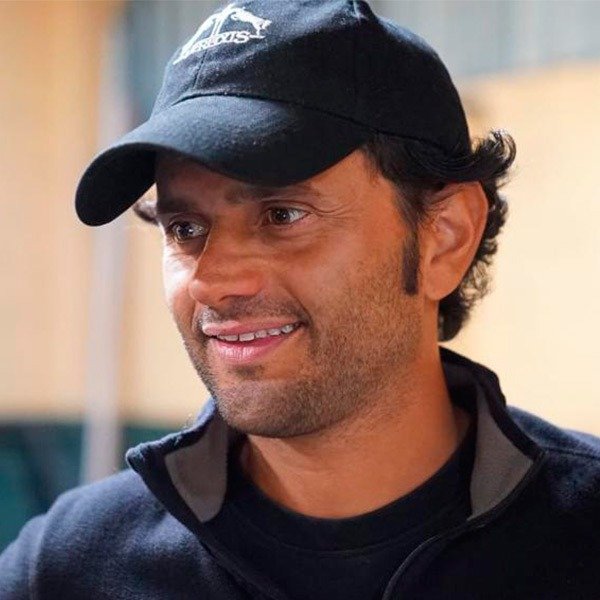
Javier González Fraga's career is a likeness of absolute dedication to the world of the horse. A vet, active rider, breeder and head of the Marco das Pías Equestrian Centre, his day-to-day life revolves around a project in which all the pieces fit together: breeding, training, competition and teaching.
His connection with this world stems, as he himself explains, from a very early passion. “What I like most are animals and, particularly, the horse. From that love, everything else arose,” he points out. Although competition forms an important part of his life, he acknowledges that the origin of it all remains the daily contact with horses and with nature. “I like to compete and I like to try to do well and win, but the main reason I do this is the love I have for the horse,” he sums up.
That global vision of the horse is one of his main hallmarks. Over the years he has been able to take part in all phases of the process, from genetic selection to competition. “I am fortunate to see horses from every angle, from genetics and breeding to their development in training and competition,” he explains, highlighting the importance of understanding each stage in order to make the most successful decisions.
One of the most special moments for him arrives when those horses he has seen being born end up competing under his saddle. “Riding home-bred horses is bringing the cycle to a close,” he states. Most of the horses he presents in the arena have been bred or reared in his own centre, something he considers a source of pride and motivation. “When you can enter the arena with horses of your own, everything takes on a different meaning because of everything behind it,” he adds.
His training as a vet has been a very important tool in his professional development. His in-depth knowledge of the horse enables him to better understand its needs and anticipate potential problems. “It helps you to understand how the animal works, from physiology to behaviour, and that influences decisions as important as feeding or training,” he explains. However, he acknowledges that experience remains the most decisive factor: “From the moment I get up until I go to bed I am with horses, and that continuous practice is what teaches you the most.”.
In the field of breeding, his way of working combines analysis with a certain amount of intuition. He closely observes the genetic lines that are proving successful in international sport and seeks out crosses that provide guarantees, whilst still experimenting when he feels it is necessary. “I try to be as pragmatic as possible, focusing on the lines that produce the most horses for the sport, but there is also an intuitive part that is important,” he acknowledges.
All of this activity is centered around the Marco das Pías Equestrian Centre, a project that goes beyond competition. “I strongly believe in the idea of breeding horses and training people,” he states. The aim is for students to be able to make the most of the stud farm's infrastructure and grow in an environment where learning is constant. “It is work that feeds back into itself: they learn and, at the same time, help the project to keep growing,” he explains.
Day-to-day life at the centre is dictated by the horse's natural calendar, especially during the breeding season, when the foals are born and a large proportion of the veterinary and management tasks are concentrated. The rest of the year is organised into phases, distributing the work according to the needs of each moment. In an environment with so many horses, organisation is essential, and that is where another important factor comes into play: the team of people.
“First and foremost, it’s about surrounding yourself with a good team,” he assures. Each person’s specialisation and the correct distribution of tasks make it possible to maintain a balance between breeding, the veterinary clinic, competition, and the daily management of the centre. Without that structure, he admits, it would be impossible to sustain a project of this scale.
Looking ahead, his approach is to keep evolving without losing his essence. On the sporting side, he aims to compete in increasingly demanding events with higher-level horses. In terms of training, his goal is to continue helping the riders who work with him to grow, including his own children. And at the stud farm, the aim is to keep refining genetic selection and improving generation after generation. “This is a race with no limit. Every day you learn something new and there are always things to improve,” he states.
Even so, above and beyond any sporting or business objective, he maintains intact the idea that has guided his entire career: enjoying horses. “At the end of the day, it's all about enjoying the day-to-day with them, which is the most important thing,” he concludes.