






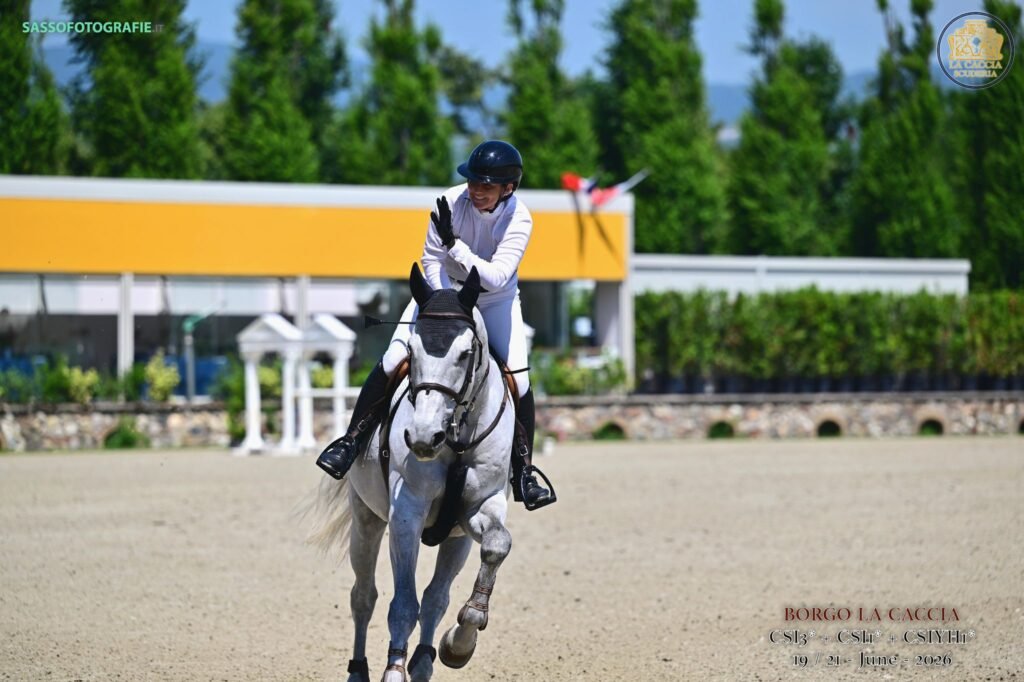
Swiss showjumper Faye Schoch is currently facing a competition that is particularly close to home in every sense. The CSIO4*-NC EEF Final in Avenches is being held just seven minutes from her house, a circumstance that makes her participation somewhat different, although she is clear that she does not want to add pressure or expectations to a sport in which she has learned to enjoy both the good times and those that leave a lesson.
Horses have been part of Schoch's life since practically the beginning. Her parents were equestrians and she grew up surrounded by them at home, although curiously her first steps were not accompanied by an immediate passion for riding. Everything changed soon: at five years old she competed in her first show with a Shetland pony and, at seven, her first D-pony arrived. From then on, her career progressed quickly. “I think, deep down, I always knew I wanted to be a rider,” she acknowledges.
Over the years, there have been many ponies and horses that have left important memories in her career, but there is one moment that stands out in particular: her two consecutive golds at the European Pony Championships with Machno Carwyn. If winning the first was already extraordinary, returning the following year to repeat the title had an even greater significance for her. “Winning gold once was incredible, but coming back and achieving it a second time felt different,” she explains.
Currently, one of the foundational names in her stable is Cornetto DB Z, a horse that came into her life in a very different way to how their shared history ultimately turned out. Schoch bought him as a four-year-old as an investment, and initially, it was never planned that she would be his rider. However, various circumstances ended up bringing them together.
The beginning was not easy. Faye describes Cornetto as an extremely sensitive horse with a very strong character, enormous power and a lot of talent. But also as a horse that needs something much deeper to give himself to his rider. “He will only fight for his rider if there is mutual trust, respect and love,” she points out.
Building that relationship took them more than two years and, as she admits with a laugh, it is still an ongoing process: “I think he's finally starting to like her.” Precisely this evolution makes her story with Cornetto DB Z also an example of the importance that Schoch places on time and trust in the formation of a partnership.
Camira represents practically the opposite character. The Swiss showjumper defines her as a fighter, an extraordinary athlete and a mare who thoroughly enjoys the sport. An injury kept her away from the arena for a long period and now the pair are continuing to work on her comeback. For Faye, one of the best signs is seeing Camira's excitement every time she gets back on the lorry to go to a competition.
They are joined by Destiny’s Pleasure, a nine-year-old mare that Schoch bought when she was a foal with an initially much simpler goal: to keep company with another filly she had bred herself. The result turned out to be unexpected. “She turned out to be much better than the one I bred,” she says with humour. Destiny’s Pleasure has enormous ability, although she is still green and needs more time than other horses to finish developing.
In addition, Faye keeps two other five-year-old horses at home, which she is progressively bringing on. Her philosophy with youngsters is precisely not to demand too much of them and to give them the necessary time to progress.
The preparation for Avenches has not meant a break with that way of understanding work either. Before the Swiss fixture, Schoch competed for two weeks in Belgium and subsequently gave her horses a weekend off. A significant part of her training takes place away from the arena, taking advantage of Switzerland's many hills to work on their physical condition.
During the competition season, she hardly jumps at home. Her priority is to keep the horses fit, but also happy. They spend a good part of the day out in the field and Schoch tries to limit her schedule, normally, to one or two shows a month.
That approach is also closely linked to another fundamental part of her life: she is a mother of two small children. Finding a balance between competition and family is part of her daily routine, and contests have even become a small personal sanctuary. “They're a bit of my ‘me time’; I almost view them as a mini-holiday,” she admits.
When she is not competing, her day usually starts after dropping the children off at school. Around 8:30 she arrives at the stables and prefers to ride during the mornings, devoting time individually to each horse. Whenever she can, she grooms them herself before riding, fitting it around her appointments and her children's school schedule.
He also tries to set aside time every day for running and physical training, while the afternoons are mainly dedicated to his commitments and the children's activities. The horses go out three times a day: they spend some time on the horse walker first thing in the morning, afterwards they work with her, and then they stay out in the field until roughly four in the afternoon, always depending on the weather.
This routine reflects a philosophy that Faye summarises in three concepts: “Trust, respect and love”. For her, there is no single correct way to build a horse. Each one has a different jumping technique, mindset and personality, and the rider's job also consists in knowing how to accept that.
“The truly important thing is to accept them as they are and build a bond with them. If you believe in them, even if no-one else does, they will give it back to you. They feel everything,” she states. Schoch likewise recognises that not all horses and riders manage to connect, something she considers completely natural. “It's like people: we all have different personalities and chemistry, but when you manage to create that bond with a horse, it's magical.”.
With this philosophy she now arrives in Avenches, a venue that has a special component due to its proximity. Despite being Swiss, she admits that she does not compete very often in her country, so having a competition of this level literally seven minutes from home represents a different opportunity.
However, he doesn't want to turn that circumstance into a source of pressure. Years of experience have taught him that, even when a pair arrives prepared and in top form, the result is never guaranteed. “Sometimes you win and sometimes you lose. No matter how prepared and fit you feel, sometimes things simply don't go the way you want.”.
That is why she approaches Avenches with a simple idea: with no pressure or expectations, enjoying every round and also seizing the opportunity to learn by observing the top male and female riders taking part in the competition. For her, even bad rounds are part of the journey if they are used to learn.
Following Avenches, her 2026 season will still continue. Schoch plans to compete in three or four more shows in Italy, all of them three-star competitions, but without setting herself major sporting objectives before the end of the year.
He is even considering giving up the indoor circuit this season to give his horses a break of at least two months without competitions during the winter. His schedule involves much lighter work through November and December, keeping them active with hacks and exercise adapted to the weather conditions, but without jumping.
The goal will be to make a progressive start again in January and arrive prepared for the Sunshine Tour in Spain in February. It is a plan that is entirely consistent with the philosophy behind Faye Schoch: keeping her horses fit, well-muscled and, above all, happy.