


Galician riding instructor Xabi Blanco has built his teaching approach around a seemingly simple idea: before seeking results, you must learn to ride. From his equestrian center, Atlántico, he dedicates his time to training riders, especially children, while sharing on social media a vision of horsemanship that emphasizes balance, simplicity, and understanding the horse.
In an interview with Chacco Marketing, Blanco recalls that his entry into the equestrian world was almost accidental. It all began during a birthday celebration at a riding stable.
"What I felt when I climbed onto that horse changed the script of my life," he recalls.
First he was a student, then a competitive rider, and finally a teacher. Although he acknowledges that any profession related to horses could have ended up becoming his job, teaching always held a special place for him. In fact, he says that if he hadn't dedicated himself to horses, he probably would have been an early childhood education teacher.
Today she works training children from a very young age and places special emphasis on building a solid foundation. Safety, patience, and balance are three essential elements in her classes, where she uses metaphors and examples to help the youngest children understand a sport that can be complex during their first steps.
"For me, before teaching how to jump, you have to teach how to ride."
His emphasis on balance also predates his relationship with horses. His first sport was trial motorcycling, a discipline in which balance is fundamental. When he began riding, he quickly discovered a parallel, albeit with one essential difference: a horse is not a machine.
"We are working with an animal that is alive, that thinks, feels and reacts. That is why, for me, balance cannot be separated from understanding and connecting with the horse."
That way of thinking wasn't always exactly the same. Blanco explains that he received training based on traditional and highly technical horsemanship, but over the years he began to simplify his riding and working style.
The change became especially evident when he left the center where he trained and rented his own club. Spending time alone with the horses, he explains, led him to listen to them and try to understand why they reacted in a certain way. Little by little, he began to do away with things he considered unnecessary, to ride in a more natural way, and to work from simple exercises and a solid foundation.
"I realized that I knew a lot about the track and training, but I knew nothing about horses."
For Blanco, this process has allowed him to develop a riding style with his own unique stamp and, above all, to become a better teacher and rider.
"Spending time alone with a horse has taught me to understand and care for it better, no longer treating it like an object."
This philosophy also extends to Atlántico, the center he describes simply as "my home and the home of my horses." There, he says he dedicates practically all his time to ensuring the horses are happy and healthy and to working with his students without paying too much attention to the clock.
"I put my heart and soul into every class. That's why it's impossible for me to finish the hour, and I give classes that are almost two hours long," he jokes. "I don't stop until I achieve what I want on the track."
He doesn't necessarily look for a specific level or particular qualities in his students. For him, two much more important requirements are confidence and perseverance.
"I just need kids who trust me and are eager to fight, because there are going to be more bad days than good ones and we're going to suffer together on the track."
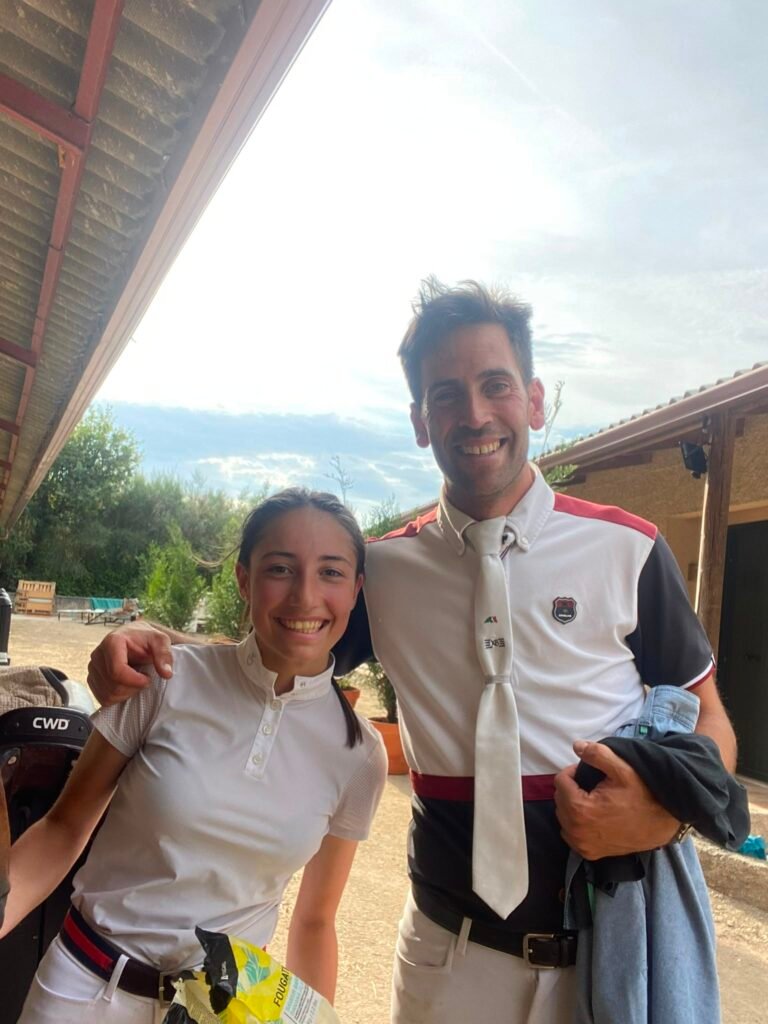
Of all the people who have passed through her classes, she holds a particularly special memory of Candela Suárez Torres, her first student and member of her first competition team. Together they experienced her first participations in the Spanish Championships, her first medal, and some of the team's first successes.
Twelve years later, Candela is still by his side.
"That shows that my first client is still here, that he hasn't left, and that strengthens me."
At the same time, Blanco has managed to expand the reach of his teaching methods significantly thanks to social media, where he has built a community of nearly 40.000 people. However, he maintains that there was never a particularly elaborate strategy behind this growth. It all started when someone attended one of his classes and suggested he record them.
"It all started with something as simple as turning the camera."
He thus stopped limiting his publications to photographs of competitions, podiums or students and began to show his real day-to-day life: classes, training, explanations and reflections, combined with his sense of humor.
"If people come to my house, they'll see that I'm the same as on Instagram, even a little taller," he says, laughing.
She didn't expect to reach those numbers either. First came 10.000 followers, then 20.000, and finally a community that continues to grow. Even so, her priority remains off-screen.
"Where I want to go far is with my students and in the day-to-day life of my horses."
Her content also doesn't usually reflect any specific preparation. If she's training a horse, giving a lesson, or working at the center, she simply turns her phone around and shows what's happening. She believes that this naturalness is precisely one of the keys to her profile.
"Nothing is planned or pre-planned. If you come to my house one day, that's my Instagram."
Looking to the future, Blanco doesn't dream of leaving Galicia to increase his presence in competitions. His goal is much closer to home: to continue developing his project and turn his center into a place where riders from all over Spain can come to train with him for a day, a week, or even longer.
"I would like to be a role model and for people to know that they can come to Galicia, set up with me, and that I can help them in any way I can."
He's not concerned about the skill level. From someone who wants to learn to trot to a rider looking to perfect their canter or solve a specific problem with their horse or pony, he welcomes all. His intention is to continue working at his center, close to his family, opening its doors to anyone who wants to learn.
And precisely training is the advice he considers most important for anyone starting out in horse riding.
Blanco emphasizes the importance of choosing a good riding school and acquiring a solid foundation before thinking about competing, jumping, or achieving results. He considers it essential to learn slowly, work on position and seat, and above all, understand the horse.
"Let them get trained. In the end, in life, what we have left is what we have in our heads, and if we get a good education, we can do things well."
His message sums up a philosophy that runs throughout his career as a teacher: less rush to arrive and more time to learn.
"A simple school that provides a good foundation, that teaches how to understand the horse and give it affection. Not so much competition, so much jumping, so much winning and so many medals."
A way of understanding horse riding in which the goal is not only to overcome obstacles, but to first learn to ride, listen to and understand the horse that is on the other side of the reins.