


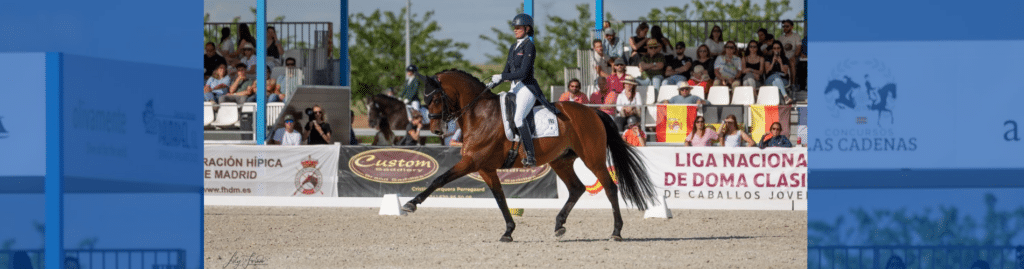
Yvonne Losos de Muñiz, an Olympic equestrian from the Dominican Republic currently based in Asturias, is well known for her precision and harmony in the arena. She has extensive experience on the world's best stages, and today she shares with Chacco Info her best tips for teaching and perfecting two of the discipline's most demanding exercises: the piaffe and the passage.
Before beginning these exercises, Yvonne emphasizes the importance of ensuring the horse is physically and mentally prepared. "The most important thing is that the horse has enough strength and balance to sit, meaning it can flex its hindquarters, lowering its croup, and clearly understands our aids, which should be very light," Yvonne explains. According to her, it's important to first take very small, self-balancing steps, allowing the horse to lengthen its neck forward. This is her methodology because "the closer these small steps are to the starting position, the more clearly the first piaffe steps appear."
Regarding the basics a horse should have before starting to introduce these exercises, Yvonne insists that "they must master short strides at a walk in self-balance," since this is what creates the foundation.
The rider also talks about how she adapts her training depending on the type of horse, knowing that not all horses have the same aptitude. "It all depends on their conformation and temperament. There are horses with bodies that can perform these movements easily, but they aren't as mentally active. Others, with less favorable conformations, like a high croup, but with a very active temperament, perform the movements more easily," she explains.
Patience is another aspect that Yvonne uses. "Patience is always the main factor when you're teaching horses something," she states firmly.
When asked about the horse's mental and physical relaxation, Yvonne says: "I always train with lots of breaks and by changing the exercises, so they don't feel like it's hard work. Rewarding them is also important, because that way they want to do the movement knowing they'll get something positive in return," she says.
Groundwork to teach these exercises is another element that Yvonne uses selectively depending on the horse. "It depends on the animal. Some learn easily from the saddle, while others do better on the ground," she says.
One of the most common mistakes she observes when teaching piaffe and passage is that correct movements are generally not rewarded. "The most frequent error is not immediately rewarding the first two good strides. When the horse begins to understand what is being asked of it, many riders continue to insist on the same technique in the same session, which generates frustration and stress," she states.
Finally, Yvonne shares with Chacco Info how she determines the ideal time to introduce these exercises. “When the horse is able to collect itself and maintain its balance, that’s when I start experimenting with the idea of leading them into piaffe. I test them from a young age, but only up to the point where it becomes easy for them. Some achieve it quickly, and others need more time,” she concludes.