



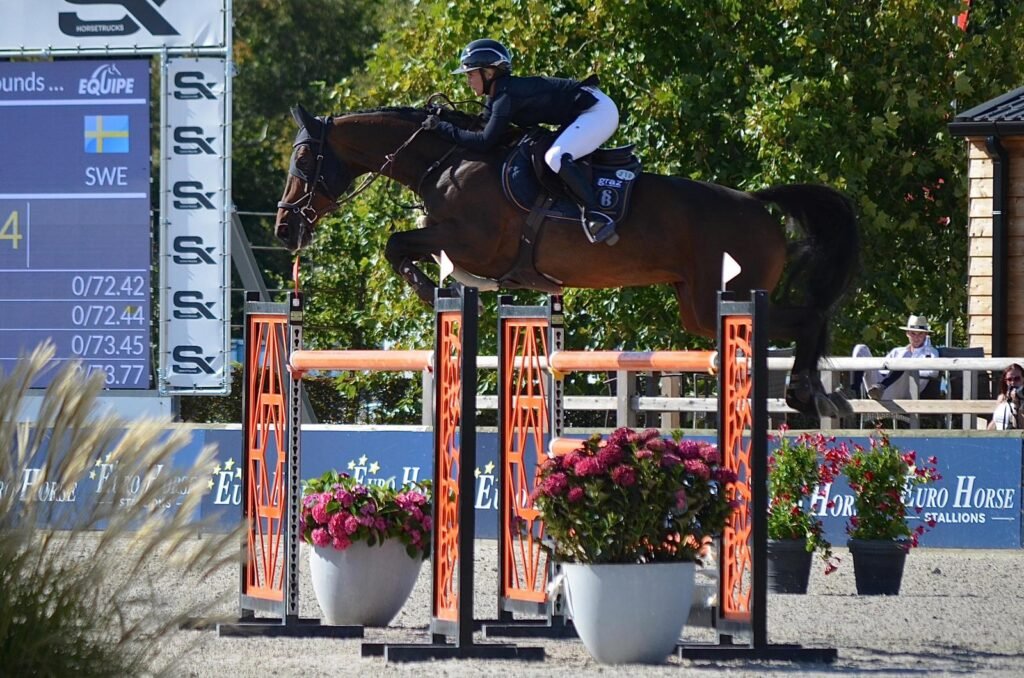
Swedish rider Lovisa Stintzing faces a new international opportunity this week in Avenches, where she will compete individually in the Longines EEF Series Final. Currently based in Switzerland, just an hour from the competition venue, Stintzing arrives with BS Chaccalina, BS Karajanka, and BS Esayas, three very different horses that reflect much of a career built on hard work, patience, and above all, faith in horses that others didn't always believe in.
Her story with horses began long before she imagined she could one day dedicate herself to them professionally. From childhood, every horse that appeared before her eyes immediately captured her attention. “I would run towards it to hug it, and then my parents would have to listen to me for an hour asking, ‘Mom, please, why can’t I have a pony?’” she recalls.
Lovisa doesn't come from an equestrian family and grew up on the outskirts of Stockholm. During those early years, she didn't even know it was possible to make a living with horses outside of a riding school or boarding stable. Her family couldn't afford to buy her a pony, so she spent her childhood learning at a riding school.
The situation changed when she turned 15. Her parents had realized that this passion, far from disappearing with adolescence, only grew stronger, and finally, her first pony arrived. “It wasn’t a superstar, but it was a great teacher for my level and meant everything to me.”
Back then, I watched TV and admired figures like Malin Baryard, Jos Lansink, Piet Raijmakers, Ludger Beerbaum, and Meredith Michaels-Beerbaum. Competing at 1,00m, that world seemed so distant that I barely allowed myself to imagine being a part of it. However, I admit there was a little voice that kept telling me, "Someday." Even if it meant dedicating my whole life to it. And that, precisely, was what I wanted.
Her career has been marked by a reality different from that of those who can learn alongside experienced horses. Lovisa explains that she never had that opportunity and that, for years, she worked mainly with horses that hadn't worked out for other people or with young horses that later had to be sold.
Therefore, some of the achievements she values most are not necessarily among her greatest sporting results. She especially remembers a mare that had lost confidence at age 13 and with whom she gradually regained her composure until reaching a level neither of them had previously attained. Together they completed several CSI2* Grand Prix events, which at the time also represented the highest level achieved by the rider herself.
“Gaining her trust and moving up one or two levels together meant so much to me,” she acknowledges. She experienced a similar feeling when she qualified another horse for a CSI3* test at 1,50m after several people had assured her when she was young that he would never jump higher than 1,35m.
It is precisely those horses that have defined his philosophy: "It's curious how much they can improve when someone simply believes in them."
Currently, BS Chaccalina holds a key place in her stable. Her owner bought her unbroken at four years old at a Schockemöhle auction, and Lovisa admits that if she had been asked for advice after seeing the video of her jumping freely, she probably would have recommended against buying her.
The mare charged at the obstacles, didn't seem particularly careful, and wasn't particularly impressive either. After being broken in by a professional specializing in difficult young horses, she arrived at Lovisa's stables and began a process that would require enormous amounts of patience.
Getting her on was quite an undertaking at first. She was extremely sensitive and could be startled by any movement from the rider. Lovisa couldn't even wear certain jackets that made noise because her reaction could become uncontrollable. Something similar happened with obstacles: she would stop at practically any jump or cavaletti the first time she saw it.
The solution was to wait. For approximately six months, Lovisa worked without knowing for sure if that behavior would eventually change. Five and a half years later, BS Chaccalina is a completely different mare, although she retains a strong character and extraordinary sensitivity.
Her mouth is especially sensitive and reacts immediately when she senses tension in her rider's seat. "My biggest challenge is not to disturb her while still helping her when she needs it, but in a way she doesn't even notice." She's even developed a peculiar pre-competition signal: when she's in top form, she starts kicking just before entering her course. For Lovisa, it's a sign that she's ready to give it her all.
BS Karajanka has followed a similarly unique path. Her owners bought her as a filly after seeking advice from Lovisa, who found her pedigree interesting. She remained in the field until the autumn of her fourth year and then came directly to them to begin her training.
The first few months weren't easy either. She wouldn't work on the lunge line to the left; she would stop moving when someone sat on her, and the combination of a difficult mouth and a long, stiff body made her hard to even guide. While two other horses broken in during the same period were progressing daily, Karajanka continued to give Lovisa pause, and since she had been the one to recommend her purchase, Lovisa felt a special responsibility.
Her perseverance and the support of a trainer who insisted they were on the right track eventually paid off. Today, she describes her as an extraordinarily gentle, sensitive mare, willing to do anything for her rider. A small request to increase the pace can easily turn into too much of a canter or create tension, but Lovisa considers it her responsibility to learn to manage that sensitivity and a quality she describes as exceptional.
The third member of their team for Avenches will be BS Esayas, a horse they bred themselves. The son of Eldorado, he has a very particular character. During his early years, he was extremely shy and distrustful of people. His great size and power could make him intimidating when he raised his front legs at something unfamiliar, although behind that first impression, Lovisa describes a kind and extremely curious horse once he understands he can trust someone.
Esayas competed in his first competition last May, at the age of six, so he still has little experience for his age. Currently, his training focuses exclusively on gaining experience, without any pressure regarding results. Lovisa describes him as “my gentleman”: a horse who keeps trying even when he starts to tire and who clearly shows how much he enjoys jumping, playing, and bouncing when he understands what's in front of him.
In addition to these three horses, Lovisa also has three promising six-year-olds at home who are still in the early stages of their training. She explains that they prefer to start working with their horses a little later to allow their bodies to develop further. There's also Hello Pitchoune, a nine-year-old mare who has just returned from a break from competition and isn't yet ready for a competition like Avenches, as well as other five- and six-year-old horses that she and her partner work with.
When she's not competing, her routine revolves primarily around riding. Her owners breed horses, so she always has numerous young horses in training. She typically rides between six and nine horses a day and tries to distribute her workload so that each horse gets several days off during the week. The problem, she jokes, is that this system doesn't allow for a day off for herself.
She has a team she considers essential: a skilled rider capable of riding any of her horses, her partner, who takes care of everything she can't manage alone, and her groom. They all collaborate in the daily care of the horses.
The scheduling of competitions, however, falls squarely on Lovisa's shoulders and becomes a real puzzle. She must combine international competitions for more experienced horses with national competitions for younger horses or those needing training courses. The difficulty increases in Switzerland, where she explains that national competitions must be planned four to six weeks in advance to guarantee a place, while sometimes she doesn't know if she'll be able to attend an international competition until barely a week before.
Avenches, a competition with special significance, now appears on that calendar. Stintzing lives about an hour's drive away and knows many of the people involved in organizing it, so competing there feels almost like competing at home.
Furthermore, the EEF Final significantly limits the number of available places, and federations carefully select their representatives. Although she will participate individually and not as part of the Nations Cup team, Lovisa is proud to have been chosen to compete representing Sweden.
Her expectations, however, remain unchanged despite the importance of the competition. Her goal is to achieve good, safe courses that will allow both her and her horses to continue progressing. “I like to finish a competition feeling better than when I arrived four days earlier.”
That idea has become their motto: “Better than yesterday.” And it doesn't necessarily mean achieving a better result, but rather delivering a better performance. Lovisa is confident that if they can maintain this progress, the results will eventually come.
In Avenches, he will have BS Chaccalina, whose extreme sensitivity and physical ability allow him to lengthen and shorten quickly without losing power; BS Karajanka, in whom his sensitivity stands out again along with an enormous ability over obstacles; and BS Esayas, the young “gentleman” who is still discovering his potential while enjoying his work more and more.
Looking ahead, Stintzing avoids setting limits for herself. Her goal is to go as far as she can in show jumping because, as she herself points out, there's always room for improvement. Competing in a major championship, such as a World Championship or the Olympic Games, would be a huge milestone in her career.
But before even considering that scenario, he keeps his focus on what he can control each day. Horse by horse, journey by journey, and lesson after lesson, his primary goal remains the same: "to be better than yesterday."