



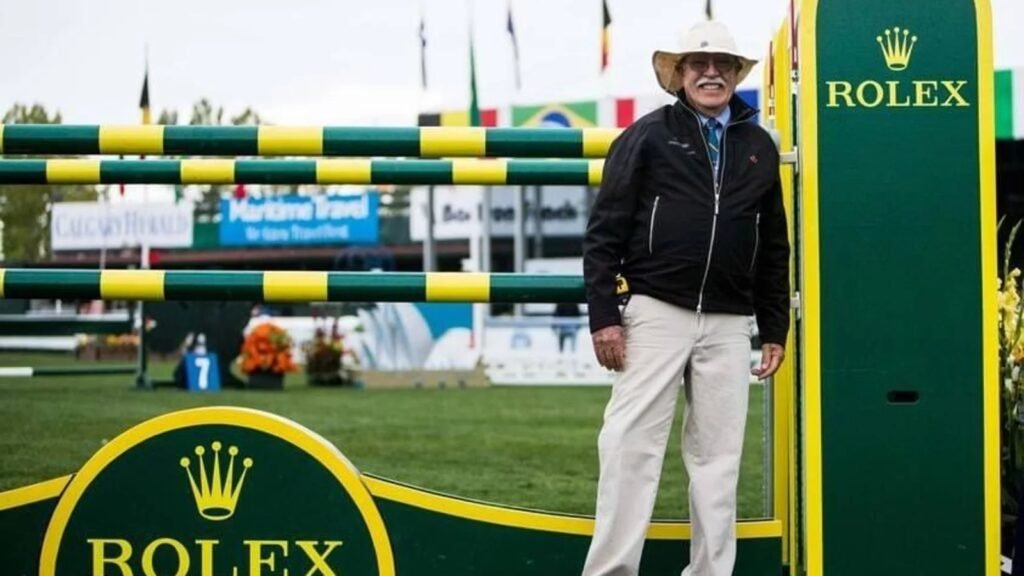
To talk about breathtaking course design is inevitably to talk about Leopoldo Palacios, one of the most renowned course designers on the international scene and an important figure in the evolution of modern show jumping.
With decades of experience in the world's most demanding competitions, Palacios has witnessed firsthand the technical, sporting, and mental changes that show jumping has undergone. In this interview, he shares his vision on how a course is designed, what he aims to elicit from riders, and where he believes the sport is headed.
An empty track and a clear idea
For a course designer, the work begins long before the first obstacle is placed. It all starts with planning and understanding the context in which the event will take place.
“I need to be clear about the type of competition I’m designing. Each venue and each competition has different requirements and objectives,” Palacios explains. This initial analysis is what defines the course's identity: the technical level, the type of challenges the pair will face, and the overall balance of the route.
The goal: the best possible sport
Beyond the difficulty or the number of zeros, Palacios insists that the goal of a course is to generate quality sport.
“What I’m looking for is to achieve the best possible sport. That requires creating a competition between the pairs where they can solve all the challenges, but always maintaining a balance between demandingness, fluidity, and respect.”
That balance is what differentiates a technical course from one that is merely difficult. The course must be challenging, but it must also allow the riders to ride and the horses to demonstrate their quality.
The great evolution: more technical horses, but less brave
If there is one change that Palacios highlights above all others, it is the qualitative leap in sports breeding.
“What has evolved the most is the quality of the horses. Breeding has become impressively technologically advanced,” he points out.
However, it also points to some consequences stemming from technical changes and modern equipment. The use of safety cups has reduced risks and improved the safety of the sport, but it has also influenced how courses are built and the type of horse that predominates today.
“The equipment is getting lighter and shorter, and that has turned the sport into a one-way street: very careful horses, but less brave. Today, horses are trained less to jump short distances or to shorten and lengthen with quality.”
He also believes that the time limits have become excessively tight, which has changed the way courses are set up and measured.
Overconfidence in the horse?
In his opinion, the modern Salto has tended towards more homogeneous routes, with less variety in construction.
“We are putting together very generic courses, with very similar distances and jumps. This means there are fewer changes in the horse's attitude and less intervention from the rider.”
As a result, he believes that many current riders rely more on the natural quality of the horse than on prior technical and educational work.
The challenge of the calendar and the lack of time to train
Another aspect that worries Palacios is the current pace of the sport, dictated by the rankings and the horse market.
“Today there are so many competitions, and riders compete almost every week. That leaves them little time to work at home and strengthen their relationship with their horses.” For him, the foundation of success remains the connection between rider and horse, a relationship that requires time and consistency off the track.
What defines a good tour
Palacios points out that the success of a race is not measured solely by what the scoreboard shows.
“For me, a good run doesn't depend on the number of zeros. What's important is that there are no accidents, that the level is appropriate for the participants, and that a good show is created for the public.”
He adds that a successful ride is one that the riders enjoy and leave with the feeling of having done a good job.
Mistakes are an inevitable part of sports.
Regarding on-track errors, his view is that there are no unique or universal mistakes.
“The difference between a clear round and one with faults is that there was a mistake, but mistakes can be for many different reasons. In our sport, faults usually result from the rider's decisions or execution.” This reflection serves as a reminder that show jumping is, above all, a sport of precision and decision-making.
Pressure, an increasingly present factor
The mental component has gained importance in recent years, especially with the emergence of new communication tools.
“The pressure is immense these days. Social media, the press, and, in some cases, the prize money have a significant influence on riders,” he says. This environment can affect both their preparation and how they approach competition.
Learn even when you don't win
Leaving aside the result, Palacios is clear about what he would like the riders to take away after completing one of his courses.
“I like it when the riders leave satisfied and feel that they and their horses learned something, even if they didn't pass cleanly.” For him, the arena should be a learning tool, not just a place to see results.
The true role of the course manager in modern show jumping
To close the conversation, Palacios summarizes the essence of a track manager's job.
"The most important role of the track manager is to create healthy competition between the pairs, where everyone has the same opportunities and it is determined who had the best performance that day."
As he acknowledges, it is a job that requires balance in order to guarantee the show, maintain safety and always respect the horse.