


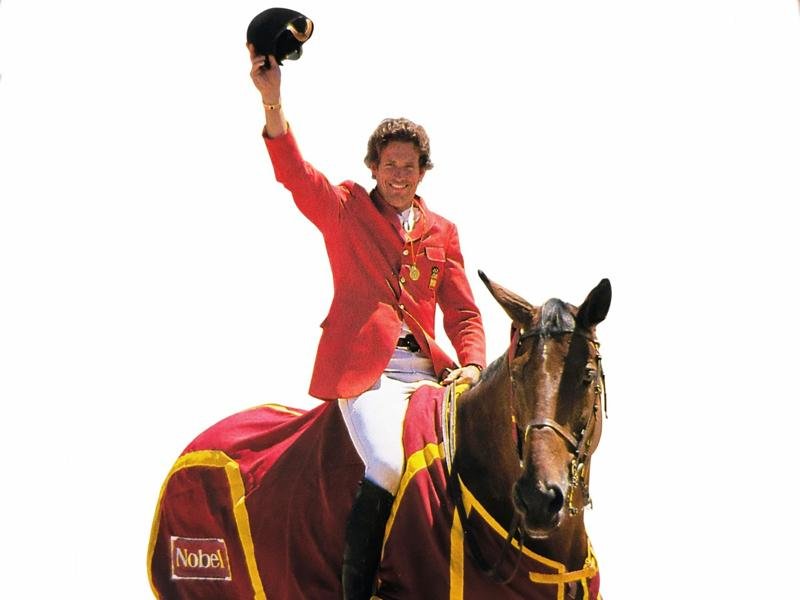
The first edition of the Spanish National Championship was in 1960, and until 1998 the final was contested with a change of horse. Alejandro Jordá was the last gold medalist under this system.
Until 1998, the Spanish National Championship maintained a format that combined skill, strategy, and a touch of adventure: the final with a horse change. This event tested not only the riders' dexterity but also their ability to adapt to unfamiliar mounts, as was also the case in the World Championship.
The Spanish National Championship began in 1960, and in its very first edition, a pair destined to leave their mark shone brightly: Francisco Goyoaga and Kif-Kif. This duo not only took gold that year, but repeated their victory in 1961 and again in 1964. They also won silver in 1963 and bronze in 1965.
For decades, the final became a unique spectacle. After three qualifying rounds, the four best riders advanced to the grand final, where they had to complete the same course with their own horse and those of the other three competitors. The winner was the rider with the fewest points after the course with all four horses.
A very attractive format for the public, but for many riders, this modality had its downside: the need to control unfamiliar horses and the added pressure were not always to the liking of the professionals. Therefore, after the 1998 Spanish Championship, held in La Granja de San Ildefonso, the final with a horse change was eliminated forever.
That 1998 edition was unique in many ways. The setting, imposing and steeped in history, was unlike those of previous editions, as were its dates, since it was held in the middle of summer. After the three qualifying rounds, the following horses reached the final: Alberto Honrubia with Quiron GH, who had won the first two rounds; Alejandro Jordá with Angelo II, winner of the third round; Juan Antonio De Wit with Filias; and Raffy Latham with Bretzel.
The final produced many memorable moments, many of which will be hard to forget. Alejandro Jordá won his first gold medal after achieving the highest total score, also securing the best result with each of his four horses. His performance was precise, demonstrating a remarkable ability to adapt to all types of horses, as he clearly showed with Quiron GH, the final's toughest competitor. With this horse, he made his only fault, improving upon the 5.25 points he had accumulated with his rider Alberto Honrubia. Raffy Latham struggled to adapt well to this horse, finishing with 15 points, as did Juan Antonio De Wit, who was unable to complete the course.
With “Angelo II”, only two riders finished without faults: Alejandro Jordá and Honrubia. With “Fidias”, the only clear round was also achieved by Alejandro Jordá, while with “Bretzel”, Alejandro Jordá and Juan Antonio de Wit finished without penalties.
Alejandro Jordá achieved an impeccable victory, finishing with 4 points. Alberto Honrubia took the silver medal, more than fifteen points behind the gold, while Raffy Latham, who totaled 35 points with all four horses, won the bronze medal.
The following year marked a turning point. At the Las Mestas show in Gijón, the Spanish Championship ushered in a new era: the final without a horse change. This meant abandoning a tradition that had demanded the utmost from the riders and provided unforgettable spectacles, but which was left behind to adapt to the modern era of Spanish show jumping.