


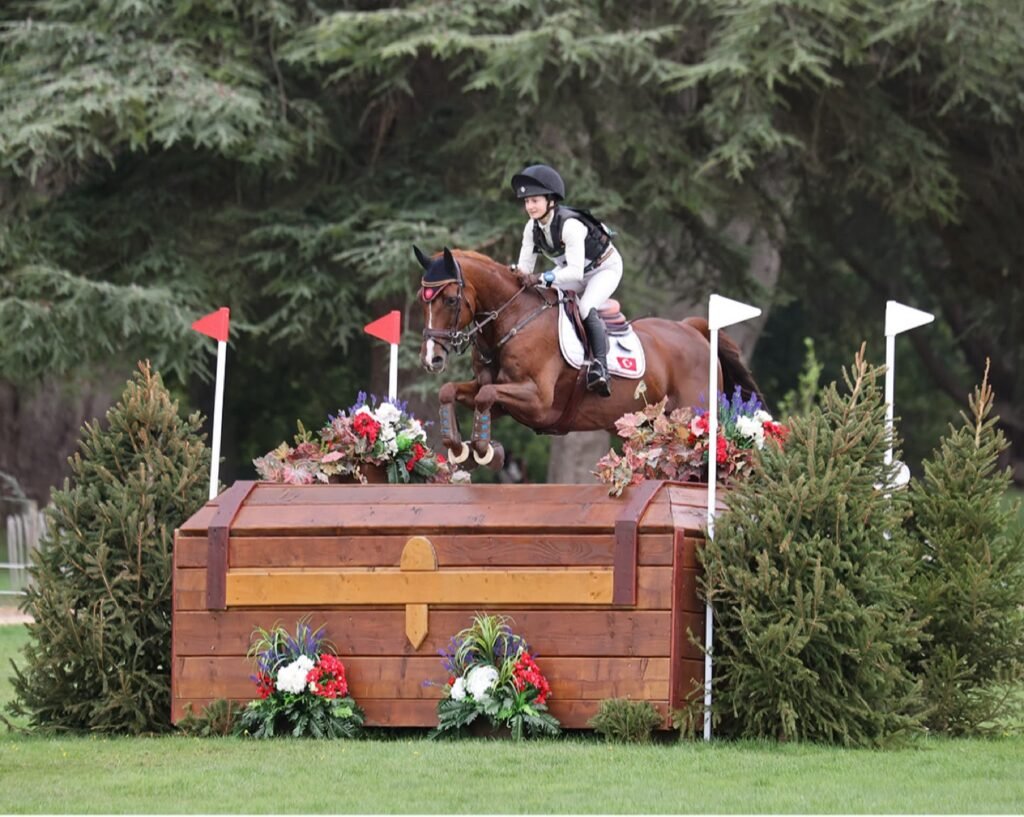
Kumru Say, known as “Kuki” in the equestrian world, faces at 25 years old one of the most important moments of her sporting career: representing Turkey in the Aachen 2026 World Eventing Championship alongside Baladin de l'Ocean LA.
A path that has not followed a conventional line and that the amazon has built working from a very young age, first in Jumping and, for just a few years now, in Eventing.
“My entire life has always revolved around horses,” Say explains to Chacco Info. Horses have been a part of his memories since childhood, from thoroughbreds and racehorses to show jumpers and, later, eventing horses. Even during his school years, his days began and ended at the stables.
“I would ride one or two in the morning, go to school, and then come back, and I still had several horses to ride. I don’t remember a single day when I thought, ‘I don’t want to do this anymore.’ It’s always been very early starts, very late finishes, and simply a part of me.”
His sporting career began in show jumping, progressing through the pony, children, junior, and young rider categories. However, his entry into eventing came almost by chance.
During his second year as a young rider, he had sold two of the horses he competed with in higher-level events and was left with a particularly difficult horse, although one with experience in junior championships and Nations Cups. A friend recommended he try it out in cross-country.
“I had never really thought about doing Eventing. I didn’t know much about the discipline, what a horse needed to do it, or how it worked.”
The experience changed his trajectory. The horse enjoyed the cross-country training and, just a week or two later, Kumru decided to take him to an eventing competition, despite never having competed in the discipline before.
“He went to a competition and did a double zero. I thought, ‘This is what he likes to do.’”
That horse would eventually compete with her in both 1,50-meter show jumping and up to three-star eventing. “I think it’s one of the best stories I have,” she acknowledges. From then on, she began to gradually introduce other young horses to cross-country and incorporate eventing horses into her training.
But her story had begun to take on an international dimension long before. At just 14 years old, she left home after receiving an opportunity involving several horses in Germany. She accepted it and never returned to a conventional life.
“I’ve spent about twelve years in Germany. I’ve worked for large operations, small breeders, buy-and-sell stables, and pretty much everything in between.”
An experience that, she acknowledges, forced her to mature quickly.
“I had to grow up very fast, and I really couldn’t be a child that age.”
In return, he was able to learn about different working systems, philosophies, and ways of understanding equine development. This learning process, comprised of numerous small pieces, now forms part of his own working methods.
His sporting career is also inseparable from his profession. Say earns a living breaking in and training young horses, as well as working with horses in production and training, a reality that makes it especially difficult to combine international competition with daily life.
“I make my living with the younger horses, so everything else comes second. Even though it’s a five-star championship, my first concern is the young horses at home. They are my job and my responsibility.”
The horsewoman acknowledges, however, the importance in recent years of having people willing to help her when the volume of work made it difficult to combine all aspects.
“I’ve been very lucky to have such good people around me. When I needed help, I could call and ask them to take a couple of horses or help me with the ones I had to show. People have helped me so much simply out of kindness.”
That support has been one of his main motivations to continue pursuing sporting goals while maintaining a workload that he sometimes describes as enormous.
In 2025, Kumru Say made history by becoming the first representative from Turkey to compete in a Senior European Eventing Championship in Blenheim. Less than a year later, the next step in her career takes her to the World Championships in Aachen.
The rider recognizes the value of paving this way for future generations of Turkish Eventing, although she tries not to place the entire weight of that responsibility on her shoulders.
“We don’t have much to go on yet. I hope the new generation can see it and think, ‘If she did it, then it’s possible.’ Maybe in a few years there will be some juniors, some young riders, and maybe in ten years there will be a team, or maybe not.”
For now, his intention is to focus on his own journey.
“I can’t focus on the whole picture because I’m on my own. I focus on my journey and my horses and try to do the best I can. It’s a privilege to compete in a Championship at this level.”
Aachen also holds a special significance for Say. Like so many other riders, she grew up watching its competitions. She even remembers keeping photos from the 2006 World Championships and visiting Aachen as a child with her mother to witness a Nations Cup around 2011 or 2012.
“When you’re a girl, it inspires you so much and you want to do it yourself as soon as possible. What I never thought was that I would be here to compete in the All-Around competition.”
His partner in this new chapter will be Baladin de l'Ocean LA, a horse he describes as extremely friendly and with a very particular personality.
“He is a very, very gentle horse. He is a bit in his own world and is very attached to other horses.”
At home, he enjoys watching Baladin interact with the other horses in the field. He often forms small groups and, interestingly, seeks out the company of more nervous horses, on whom he seems to have a calming effect.
This dependence on his companions also poses a challenge when he travels alone to major competitions, as Baladin is used to traveling accompanied by horses from his usual group.
From a sporting perspective, Say admits that he didn't always believe he would get this far.
“I myself doubted him many times. I thought he was very limited: his jump, his ability, his stride… He doesn’t have the best quality, but he has all the heart.”
It is precisely this ability to rise to the occasion that is one of the qualities he values most in his horse.
“He always rises to the occasion. That’s one of the most fantastic things you can have in a horse at this level.”
His background in show jumping is still evident in his approach to the three phases of the Eventing competition. Kumru admits, laughing, that dressage continues to be the day that makes him the most nervous.
“I feel much more comfortable in show jumping. On dressage days I'm usually very nervous. I think I'm still more of a show jumping rider.”
Cross-country running, however, has changed its approach to obstacles and its perception of distances. This evolution has been built with the help of various professionals and friends who have offered training and advice, despite not having a permanent structure comparable to that of some of the major European national teams.
“I’ve been very lucky. There are people who have simply told me: come and train on some obstacles with us. You take a little bit from each person and try to put it all together.”
For Aachen, his philosophy with Baladin has also not been to transform what already works.
“I don’t like to change the horses too much. The most important thing is to keep them happy and make them feel like they can do it.”
He also does not acknowledge feeling any different pressure for wearing Türkiye's colors in a World Championship.
“In the end, I do it for myself. I continue doing what I’ve always done. It doesn’t change for me whether I’m wearing the Turkish colors, whether it’s a major championship or a young horse competition. I simply try to do my best.”
After paving the way for Turkey in a senior European Championship and now reaching a World Championship, asking her about her next big dream gets a response very much in line with the path that has taken her to Aachen: Kumru Say prefers not to build overly rigid plans.
He continues to work with numerous young horses and allows each one of them to lead the way.
“If they are good enough for show jumping and want to jump, they will jump with me. If they want to do eventing, they will do eventing. I try to do what the horse wants to do.”
She doesn't yet know which of her young horses will one day reach the highest level of eventing or which will end up competing in major show jumping events. For now, the rider who started almost by chance in an eventing competition continues doing the same thing she has done since she was 14: working, starting horses, and keeping her mind focused on the next step.
Now, that next step is called Aachen.