


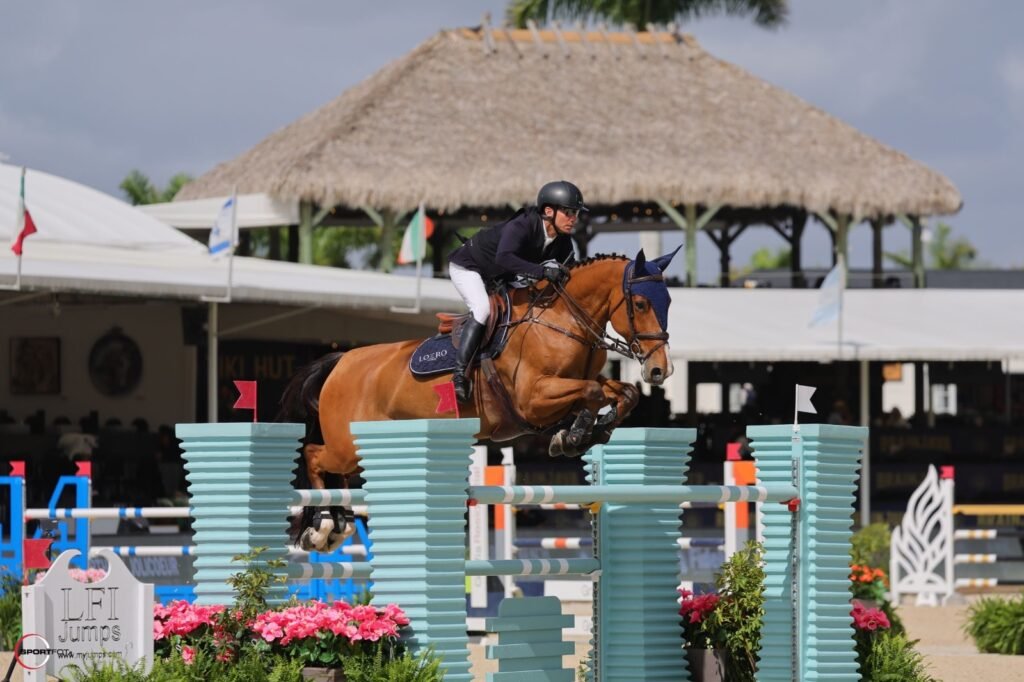
To speak of Juan Manuel Gallego is to speak of a very specific way of understanding show jumping. A way of working where the result matters, but never at the expense of the horse. From his stables in Wellington, the Colombian rider and trainer, who competes under the Spanish flag, has spent years building a project based on something increasingly rare at the highest level: patience.
Its structure combines international competition, student training, and the development of young horses—a structure where experienced horses coexist with others just beginning to explore the arena. This is where one of Gallego's most frequently repeated ideas about training comes into play: not all horses develop at the same rate.
“Many times we want to accelerate processes because the sporting calendar pushes us, but the horse always tells you when it is ready and when it is not. There are horses that at seven years old already have the mental capacity to take on certain tests and others need more time. The mistake is trying to put them all in the same mold,” he explains.
A large block, but with individual plans
Gallego's stables house a diverse range of horses: young horses in training, Grand Prix horses, and others transitioning to higher levels. Far from adhering to a rigid structure, the rider adapts each training plan to the horse's physical and mental state.
“You can have a horse with immense talent, but if you don't respect its timing, you end up losing what's most important. Sometimes you have to stop, lower the height, or simply let the horse mature. Development isn't linear,” he says.
This philosophy is reflected both in his own competitions and in his work with his students. Those who train with him know that he is not a coach who seeks quick results or unnecessary training sessions just to accumulate track time.
“My job isn’t to prepare a horse for a week. It’s to try to build a horse that can spend years competing and enjoying the sport,” he adds.
The importance of observing
Gallego places great emphasis on the ability to read small details: changes in attitude, in the way of galloping, in recovery, or even in behavior within the stable.
“Horses are constantly communicating. The problem is that we often don’t have time to listen to them. High performance cannot become an automatic routine where you only look at stopwatches or results,” he says.
Therefore, within its structure, the work is not limited to riding. Coordination with veterinarians, farriers, physiotherapists, and grooms is an essential part of daily operations.
“The well-being of the horse is not a pretty phrase. It involves decisions every day. From how it travels to when it competes or how much it rests,” he explains.
Training riders beyond the track
Although his name is linked to international competition, Gallego dedicates a large part of his time to training. And he does so from a perspective of teaching the rider how to think.
“I’m not interested in a student copying what I do. I’m interested in them understanding why we do things,” he says.
In his training sessions, he talks a lot about balance, distance reading, and emotional management. He believes that the modern rider must learn not only to ride well, but also to manage long processes and cope with the frustration that inevitably arises in this sport.
“El Salto forces you to be patient. There are weeks when everything goes easily and others when nothing works. The important thing is not to lose your way because of a bad result or go crazy because of a good one,” he says.
Build before you run
Throughout his career, Juan Manuel Gallego has consistently prioritized consistency over immediate results. This philosophy is evident both in his competitions and his training.
It's no coincidence that those who work closely with him speak of consistency. Consistency between what he says and what he does. Between how he rides and how he teaches.