



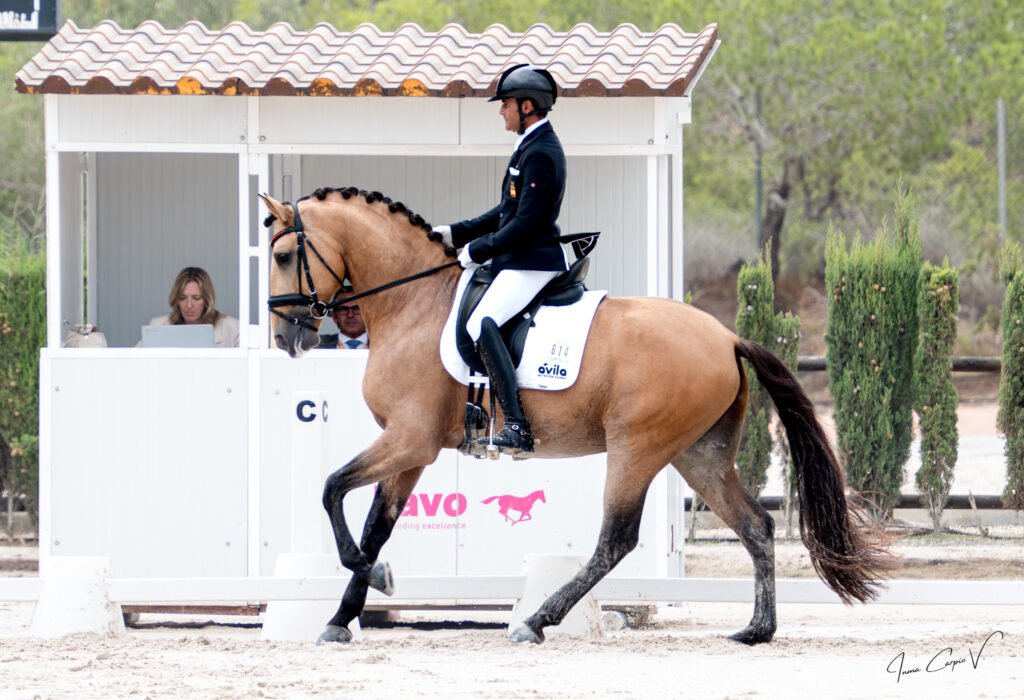
The Andalusian rider won the silver medal in the 5-year-old category with Romano, while Queluz RC and Mac Cacique finished tied for fourth in the 6-year-old category.
José Antonio García Mena finished the Spanish Young Horse Dressage Championship with a silver medal and two fourth-place finishes. He competed with Romano in the 5-year-old category and with Queluz RC and Mac Cacique in the 6-year-old category, three horses with whom he believes he achieved everything possible in this edition of the Championship.
Romano, son of Kjento, finished second in the first two qualifying rounds, with scores of 87,4% and 85,4%. In the final, he finished fifth with 80,4%, a result that earned him the silver medal in the 5-year-old category.
In the 6-year-old category, Queluz RC (Escorial) finished eighth in the first qualifier with 77%, sixth in the second with 78%, and fourth in the final with 78,8%. Mac Cacique (Cacique IX) finished fourth in both qualifiers, with 79% and 78,9%, before finishing tenth in the final with 76,2%. Both finished the Championship tied for fourth place.
“With the three horses I competed with in the Championship, all three gave their absolute best. The two six-year-olds just missed out on medals, and the gap between the bronze medal and our two horses, who tied for fourth place with the same number of points, was a bit insurmountable,” explains García Mena.
In the five-year-old category, the situation is very similar. “For me, the difference between the first three horses and mine was something we could only close by hoping they made a mistake. The points are there, and it’s clear we weren’t going to make it. It’s the same with Romano, the five-year-old. If you look at the overall standings, there’s quite a big gap between the first-place finisher, who’s the gold medalist, and us, who are the silver medalists in the five-year-old category.”
Therefore, the rider's assessment is: "With the three horses we have achieved the maximum result we could aspire to."
Season planned without rushing the colts
García Mena arrived at the Championship after a season in which the planning involved giving the horses time before starting to look for the qualifications.
“The season was pretty much planned. We waited until the colts were a little more mature to start qualifying. I didn’t start doing any tests until May,” he explains.
The idea was to leave the first few months of the year behind and start competing when the foals were more mature. “I let the beginning of the year pass, even well into spring. I only started competing almost at the end of spring to give them a little more time and begin aiming for rankings once the foals had matured a bit more.”
The plan allowed them to arrive at the national event with all three horses qualified and in condition to face the three days.
Romano and the importance of arriving fresh for the final
For Romano, the Championship also presented a new challenge, as he had never faced three consecutive races. García Mena knew he had to manage his efforts.
“I knew we had to save energy for the last day, because this horse, due to its youth and other factors, would normally find the final a little more difficult.”
The strategy was to try to maintain their freshness during the first few days to have more energy left for the final day. “I tried to conserve as much freshness as possible, and that gave me the opportunity to arrive in good shape for the final, although the fatigue was a little more noticeable.”
Queluz RC's performance was different, and the rider himself summarizes his Championship as a journey "from less to more." In Mac Cacique's case, he also had to compete in extremely challenging weather conditions.
Mac Cacique, the protagonist in the rain
“The hero has been Cacique, who had to compete in conditions that I had never competed in before, in terms of the rain,” says García Mena.
The rider, accustomed to competing in different weather conditions, acknowledges that those experienced during the Championship were exceptional.
“It has rained a lot on me throughout my life in many competitions, but like this time, I have never had so much water falling on me or so much water on the track.”
The rain on Friday made the condition of the slopes particularly difficult and was an additional factor when facing the different days.
At 6 years old, ready for the next step
The Championship served to confirm to García Mena that Queluz RC and Mac Cacique are ready to start looking towards the 7-year-old category.
“I get the feeling that with the 6-year-old colts we will perhaps soon start with the 7-year-olds, because the horses are quite well-trained and are keeping up with the 6-year-old level,” he explains.
That's why he believes the change of category comes with a good foundation: "When we face the season of the 7, I think we have it pretty well on track, well on the right track."
With Romano, however, the schedule will be somewhat slower. “Romano’s winter will surely be a little longer, because we always know that the jump from 5 to 6 years old requires more time.”
From the skies to technical work
García Mena is a regular at the Spanish Young Horse Championships and admits that he enjoys it when his horses arrive with real chances of fighting for medals.
“I love competing in the Spanish Young Horse Championships, but I am competitive and I always like to attend when we can really be competitive with what we have,” he points out.
As the foals get older, what can be assessed in the arena also changes. “As the years go by, perhaps the tests for 4 and 5-year-olds are more basic. From 6 years old onwards, you start showing, or they let you show, a little more of what you're contributing to the horses.”
Elements such as lateral work, gathering, and foot changes come into play, allowing for a clearer assessment of how the training is progressing.
“It’s no longer just like at 4 and 5 years old, which are tests where you see the airs much more, but from age 6 you also start teaching the technical work,” he explains.
That's why the 6-year-old category is one of the ones she enjoys the most. "I really enjoy the 6-year-old age group, because that's when all the work you've done previously starts to blossom and you begin to see the changes."
That's when the fruits of the work done during the previous months begin to appear: "There are horses that start with the fairly easy series, the collection of the canter for the pirouettes... You feel how it is sitting down and there you start to see a little bit how everything is blossoming."
With Queluz RC and Mac Cacique ready to face the 7-year-olds, García Mena is already looking ahead to next season. “Next year’s season is going to be a lot of fun.”
Photograph by Inma Carpio.