


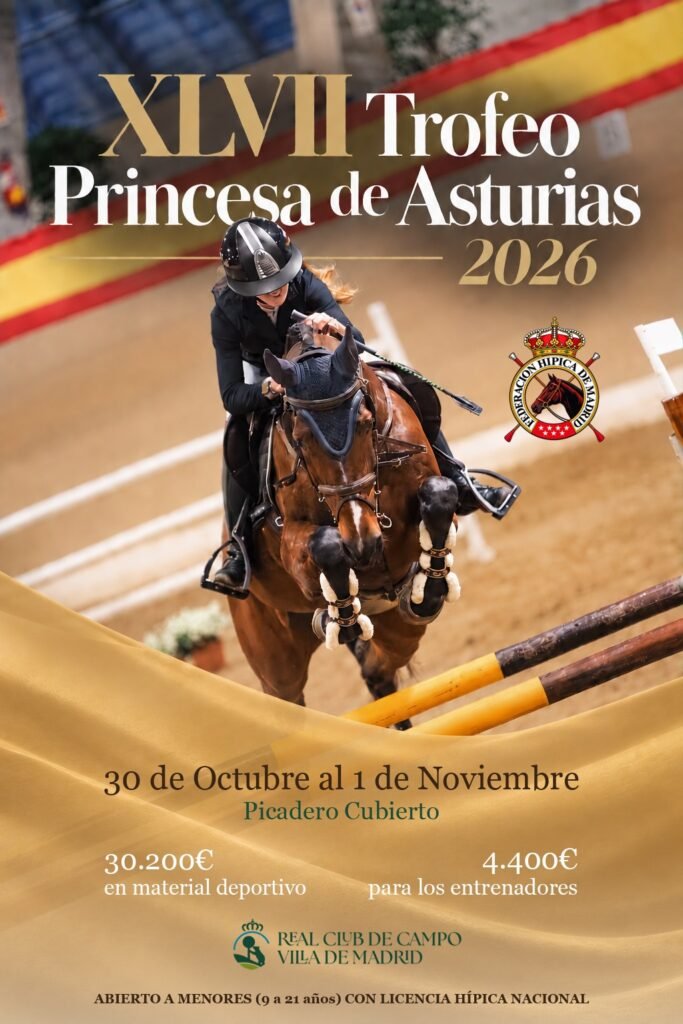
The Princess of Asturias Trophy is preparing to celebrate its 47th edition, from October 30 to November 1, 2026, at the Real Club de Campo Villa de Madrid.
A competition that, since its origins in 1977, has accompanied the evolution of numerous generations of riders and amazons and that, over the years, has become one of the benchmarks of the national Show Jumping calendar for the junior categories.
However, to understand its history, we must go back almost five decades, when it was still called the Prince of Asturias Trophy and Spanish equestrianism was looking for new opportunities for its young talents to compete against each other.
This competition was born in 1977, established with the aim of offering the best young riders a sporting event where they could test their skills against other participants. This is documented by the Madrid Equestrian Federation in the information published for the 30th edition, held in 2008, when they described the Trophy as the most important indoor competition in Spain for both age groups.
In its early years, the competition was linked to the then Central Regional Federation and gradually expanded its participation. An article published by the newspaper El País in November 1981, coinciding with the fourth edition, noted that that year, for the first time, participants from other regional federations were allowed to attend as guests.
The competition was held at the La Dehesa Military Sports Club in Madrid and had 58 entries in the junior category and 32 in the children's category. Among the names that appeared in that edition were Cayetano Martínez de Irujo, Rosario Cabañas, and Fernando Tornos, reflecting a generation that was beginning to make its mark in equestrian sports.
The first winners are also part of the Trophy's history. According to the historical record kept by the Madrid Equestrian Federation, in 1977 Ignacio Pérez de Herrasti won the children's category with Alciro, while Jesús Varela Bellido won the junior category with Cambalache.
A year later, Alfredo Fernández-Durán Moreno, riding Atiza, and José Montes de Benito, with Baby Ross, added their names to the list of winners. In 1980, the victories went to Iván Rodrigañez Bayón with Garza and Carlos Martín with Kazán, while in 1981 it was María Teresa Vázquez Sequeiros, with Postinera, and Enrique Isidro Rincón, with Colérica, who achieved victory.
These names offer a glimpse into a time when the Trophy was beginning to forge its own identity within the national show jumping scene. Each edition added new pairs to a list of winners that today also stands as a testament to the evolution of youth competition in Spain.
Throughout its history, the competition has been held at various venues in the Community of Madrid. The La Dehesa Military Sports Club hosted, among others, the 1981 and 2008 editions, while in 2015 the competition took place at the UCJC Sport Club in Villafranca del Castillo, a venue that hosted it again in 2022.
Currently, the Real Club de Campo Villa de Madrid is the venue for the Trophy. Its indoor riding arena hosted the 2025 edition and will welcome participants again this autumn, thus maintaining the competition's historical connection with Madrid.
Its name has also evolved. Originally named the Prince of Asturias Trophy, under the title then held by Felipe de Borbón, it became known as the Princess of Asturias Trophy after the change in the monarchy in 2014, when Leonor became Princess of Asturias. The official federation documents from 2015 already reflected this new name.
The passage of time has also brought changes to its sporting structure. From those early editions aimed at children and young people, it has evolved into a program that currently comprises four categories: Children, Juniors, Youth, and Young Riders, with participants between 9 and 21 years old.
The 2026 edition will maintain this format, with two qualifying rounds and a final for each category, spread over three days. This system allows the pairs to tackle different courses, and consistency is of particular importance.
Last year, the honor roll once again included new names. Maddi Arruza Rodríguez, riding Ceylan, achieved victory in the Children's category; Rafael Velasco Montilla, with Amarylis de Olid, triumphed in the Junior category; Ízaro Junquera López, with Danah, won in the Youth category; and Paola Alea Caballero, riding Indigo Blue Biolley, reached first place among the Young Riders.
But the historical importance of the Trophy is not solely explained by its winners. For decades it has offered young riders the opportunity to compete outside their usual environments, meet participants from other autonomous communities, and gain experience in a national competition.
It has also allowed teachers, coaches and families to share an important part of the children's sporting growth, accompanying them in a stage where each journey represents a learning opportunity.
Almost fifty years after its creation, the Princess of Asturias Trophy retains much of the idea that motivated its birth in 1977: to offer new generations a space in which to compete, learn and continue to advance in show jumping.
From October 30th to November 1st, the Real Club de Campo Villa de Madrid will once again open its doors to a new generation of riders. Some will seek to add their names to a list of winners that began almost five decades ago; others will participate for the first time. All will become part of a story that continues to unfold within Spanish equestrianism.