



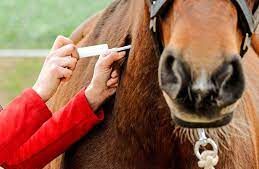
Deworming and vaccination are two simple preventative medicine routines. Therefore, it is highly advisable to deworm and vaccinate our horses regularly.
In the case of deworming, some owners prefer to collect a fecal sample and have it analyzed before administering a generic medication to the horse, thus specifically targeting the parasites present. In stables, equestrian centers, or places where many horses live together, it is common practice to deworm all the horses every 3-4 months or whenever parasites are detected in any of them. Horses that are moved to a new location are also usually dewormed, because there will likely be different parasites there than those common in their place of origin. Furthermore, it is very important to vary the active ingredient each time, so that the parasites do not develop resistance.
Vaccinations must also be kept up to date. Annual flu vaccinations are recommended, or every six months for horses that compete. While the flu doesn't have a high mortality rate, it is highly contagious. As for tetanus, annual vaccination is also recommended to protect the horse in case of injury or cuts, as this disease can be fatal.
While it is true that it is impossible to protect our animals one hundred percent, any preventative measure will greatly reduce the clinical signs.